Originally published to X on Aug 22, 2023.
The pride of Cupertino rarely dives into a major new product category, and when it does happen, it’s usually headline-worthy. In 2007, Apple announced the iPhone to a chorus of “meh.” Three years later, the iPad faced similar cynicism. The same can be said for Apple Watch in 2015. Critics made similar points for each new gadget.
“Who is this for? It doesn’t do enough! It’s too expensive.”
Yet each of those products has become integral to the lives of those living in the Apple ecosystem. In 2023 many won’t leave their house without an iPhone in their pocket, an iPad in their backpack, and an Apple Watch on their wrist.
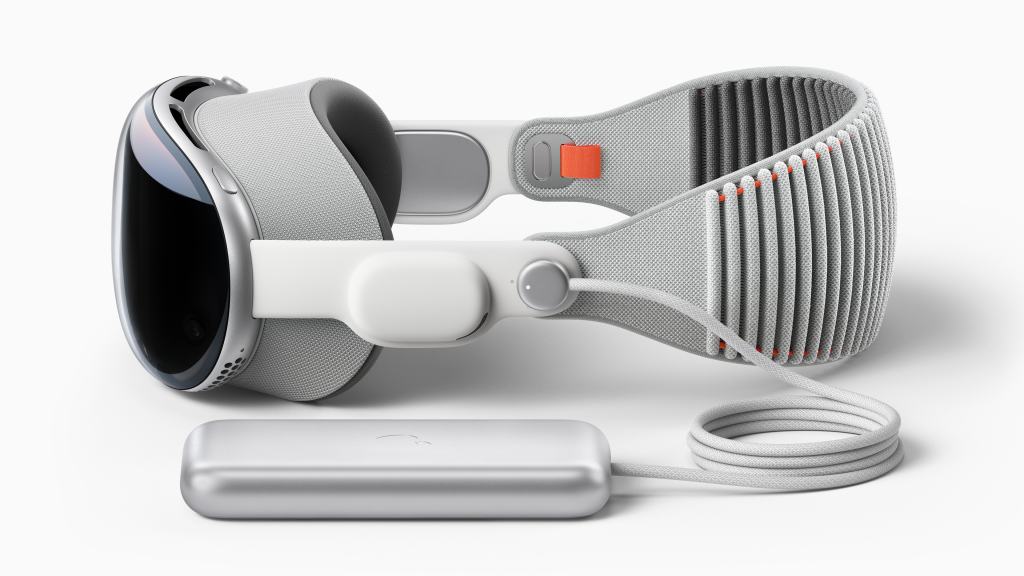
In 2023, the world finds itself in a familiar situation. Apple has announced its first foray into the “spatial computing” market, and although the new buzzwords may be Apple-speak for augmented reality, the reactions are familiar.
Who Is This For?
Apple is doing that thing it does sometimes, where it creates a product that does not have an audience. After all, VR headsets have mostly been a bust despite Facebook’s rebrand to Meta and refocus on the metaverse. According to a report from Piper Sandler, only 14% of teens use virtual reality headsets, while 29% own a VR device, indicating that young people are forsaking the new technology.
It’s at least partially because current-gen VR headsets are isolating. Imagine it; you’re a teen in the year 2023. You slip into the VR world for a game or to watch a spatial experience. Your pocket buzzes. What do you do? Peel off the headset to check your phone? There are varying degrees of notification importance. It could be a push alert from your favorite rideshare app offering a special deal and it could be a text message from your grandma saying her car broke down in traffic. Either way, you have to leave the immersive world of VR to find out.
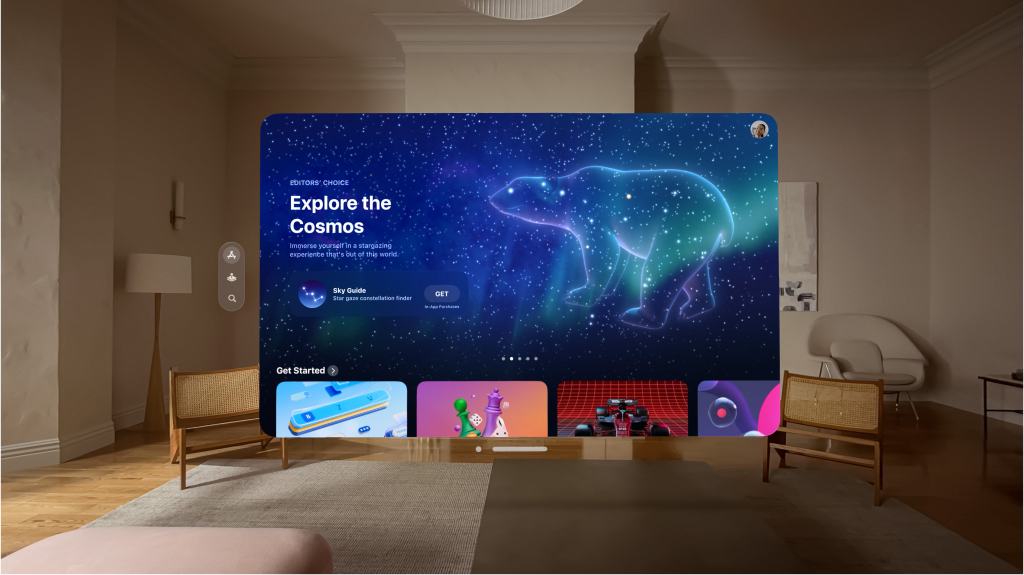
Now, enter Apple’s ecosystem. Here when your pocket buzzes, a notification pops up in the spatial environment showing you the text message from your grandma. From there, you can respond or ignore it without exiting the virtual environment. Apple’s ecosystem is the special sauce for VR. In a world where FOMO, or fear of missing out, is more prevalent than ever, only a headset that integrates all of the software that people use to communicate, stay up to date with friends, and take in entertainment, can compete with existing technology.
Still, many wonder exactly where the Apple Vision Pro will fit into their routine. Does it do enough to warrant integration into the daily lives of the average person?
It doesn’t do enough!
To many, the device seems like a superfluous hammer in search of a yet-to-be-discovered nail. A patch without a hole. But what if its place is with a growing crowd needing saving physical space?
Often overlooked are renters who, for whatever reason, whether it’s tenant rules, space limitations, or financial limitations, cannot mount an 85-inch television in their living room and deploy a booming Dolby Atmos surround sound system, lest they upset neighbors, other family members, or landlords. The Apple Vision Pro seems to be the closest a user can get to that experience without the overhead, all while best utilizing small spaces.
While living spaces for renters seem to be getting smaller and more expensive, this device has the potential to make them feel spacious. One could imagine a world where the Apple Vision Pro becomes the only device a person needs in their dwelling, allowing users to enjoy entertainment, do work, and communicate with friends and family inside that spatial environment and then truly disconnect by taking the headset off and putting it away when it’s time to unplug.
It remains to be seen if people will use the new gadget in that manner, and use cases for the new product are a blank page that early adopters can write upon. However, the Apple Vision Pro costs approximately as much as a new 85-inch TV, a 13-inch Macbook Air, and an iPhone 14, so does the prohibitive price tag limit the device’s accessibility as it develops and becomes a full-fledged Apple product?
It’s Too Expensive.
When Apple announced the iPad, the lowest-priced offering for the new device was $499. Now, a brand new iPad is available on the Apple Store for $329. Today you can buy an Apple Watch for $249, compared to the initial base price of $349. As the technology used to create new experiences matures, the price drops. How much will the $3,500 device drop in the coming years? It’s impossible to say. However, the cost will almost certainly decrease if users embrace the technology. There’s historical precedent to suggest the likelihood that Apple Vision Pro will become more affordable as it becomes more capable.
What price would Apple’s new experience have to edge out a TV, laptop, and sound system in a person’s home? Is it $2,500? $1,500? Could service providers in the future subsidize the purchase of an Apple Vision Pro in exchange for a continual subscription to their service? Imagine cable providers embracing the new technology and making it more accessible to their users like mobile services did for smartphones. Imagine a cable provider offering customers a free Apple Vision Pro if they commit to a two-year subscription to its service explicitly tailored to the spatial experience. With providers seeing more and more users cutting the cable, the Apple Vision Pro could be a route back into homes, making them relevant for a new generation of content consumers while making the device more affordable for users.
It’s hard to argue the Apple Vision Pro’s $3,500 price won’t exclude the casual user from being an early adopter of this new technology. But in that point lies the rub; those willing to embrace the costly tech will guide the product’s direction in the future. And as the bleeding tech-enthusiast forks over the enormous amount of money for Apple Vision Pro, the California company will learn more about what it should include in the product moving forward.
Conclusion
Yes, this vision, pun intended, has a lot of what-ifs. However, the beginning of a new product line is exactly the time to ‘what-if.’ Of course, it’s possible that the Apple Vision Pro could flop. Maybe the device doesn’t work as well as advertised, or maybe it’s truly a bridge too far, and users don’t want to embrace the new category. After all, statistically, people haven’t embraced VR in any meaningful way.
From the iPhone to the iPad to the Apple Watch, when Apple introduces a new product line, it usually finds its niche, even if it takes time. The Apple Vision Pro may seem initially overpriced, and before getting an in-person glimpse at the device, it may be difficult to picture it working into a user’s daily routine. That said, when looking at the company’s history and the open-ended nature of the category, it may not be a good idea to bet against Apple.




 Justin Walker
Leave a comment