Originally published to X on Feb. 16, 2024.
As I sit in a wooden chair at the Apple Store, located at the open-air Town Square shopping center, just off the Las Vegas Strip, wearing Apple’s new Vision Pro headset, my mind wanders towards the future. I find myself measuring the weight on my brow while simultaneously marveling at the crystal-clear passthrough and incredible “stickiness” of the virtual windows projected inside the goggles. It occurs to me that the importance of this device is not what it is, or even what it will be. Instead, the groundbreaking factor is intent.

Intent.
The spec list of the Apple Vision Pro is no doubt impressive. The device presents best-in-class quality on nearly all fronts, making the comparable devices from Meta look like a compromise. However, you pay to turn your nose on compromise, as the Apple Vision Pro has an eye-watering $3,500 price tag. Apple CEO Tim Cook says the price tag is to purchase “tomorrow’s technology today.”
Moreso than a price justification, I see his statement as a commitment of intent. Apple considers the Vision Pro tomorrow’s tech. The company’s intent is critical. It means that the California company is committing to “spatial” tech. As history has shown, when Apple commits to a space, it’s been known to have lasting ramifications.
It’s happened before.
I was an early adopter of the iPad. Working for a TV station at the time, I was (probably too) excited at the possibilities offered by the new device. Once again, Apple had committed to a new space. I pre-ordered and anxiously awaited as my individual device made its way from Shenzhen to my home.

My co-workers, however, didn’t share my excitement. I was mocked constantly (speaking negatively, perhaps, to the work culture at that particular location.) My manager offered to make me a babybjörn to carry around the device. A few asked me why I would want an oversized iPhone. No one got it yet. But I got it. The first-generation iPad wasn’t about what it was, but about what it would become.
It was only a short time until that workplace integrated iPads into every aspect of their work. It was amazing how fast the condescension dissipated after that happened.

History repeats itself?
While the first-generation Apple Vision Pro is a compelling device, but more compelling than today for the Vision Pro, is what it means for Apple tomorrow.
“We’ve had the Mac, the iPod, the iPad, the iPhone, the Apple Watch, now the Vision Pro,” said Tim Cook. “It’s one of those moments.”
One of those moments, indeed. The Apple Vision Pro is a flag planted firmly in the heart of the augmented reality space. The tech behemoth has now committed to developing this space come hell or high water. The 2024 model is heavy and flawed, but I get it. It’s amazing. It’s a new, more efficient way of computing, watching, and communicating. It’s still raw, but the Vision Pro is still more polished than other headsets available in the space
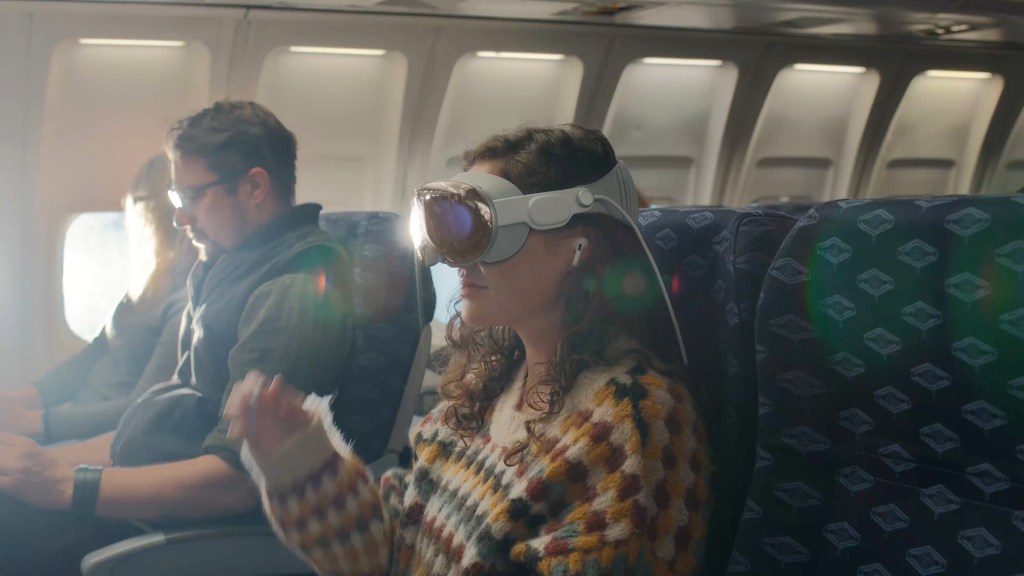
And just like the iPad, the haters are many. Some companies, like Netflix, have snubbed the Vision Pro, saying they won’t be developing apps for the fledgling ecosystem, nor would they be allowing their iPad app to be ported to the Vision Pro. History will tell whether that was the right move or not. Pundits across every media landscape have been quick to poke fun at people wearing the Vision Pro in public, or to comment on the headset’s apocalyptic ramifications.
They’re not completely wrong, it’s unlikely people in the mainstream will purchase the Apple Vision Pro in 2024. However, could it be that those people just don’t have the vision … so to speak?

This one ain’t it?
Fast forward three years, when Apple Vision is lighter, cheaper, and filled with content created specifically for the device. Will more people embrace Apple Vision Pro Generation Two?
How about three years after that? Samsung showed off its first transparent micro LED screen at the Consumer Electronics Show in Las Vegas; how difficult might it be to utilize technology found there to map projections to our actual eyes via a transparent visor instead of using cameras? What stops people from then wearing their devices all the time? Could spatial computing replace smartphones?
What an absurd thought. Except — no one thought phones would become replacements for computers before that. Nor tablets for laptops.
As I sit in that chair, witnessing what Apple has done to evolve the AR space past anything that Meta has done so far, even in its most high-end platforms, it dawns on me that if the company has deemed AR to be the tech of our future, it would be remiss for us to ignore it.
Let’s enjoy this. New spaces don’t come around all that often, and this one has the potential to change the way people live.
Or we can simply mock it.




 Justin Walker
Leave a comment