Originally published to 8 News Now on February 21, 2024.
After 2021’s Dune began playing on whichever screen pandemic-weary audiences were viewing it on, but before the credits rolled, it was unknown that the film was a “part one.” For many, the best screen available was the one in their living room, as theaters were unavailable thanks to COVID-19. Only when the title card flashed on the screen at the movie’s end did filmgoers realize they would have a second chance to enter the world of Dune with a forthcoming part two.
Three years later, the follow-up to director Denis Villeneuve’s sci-fi epic is finally seeing the light of day, and it’s every bit as unforgettable and vibrant as its predecessor.
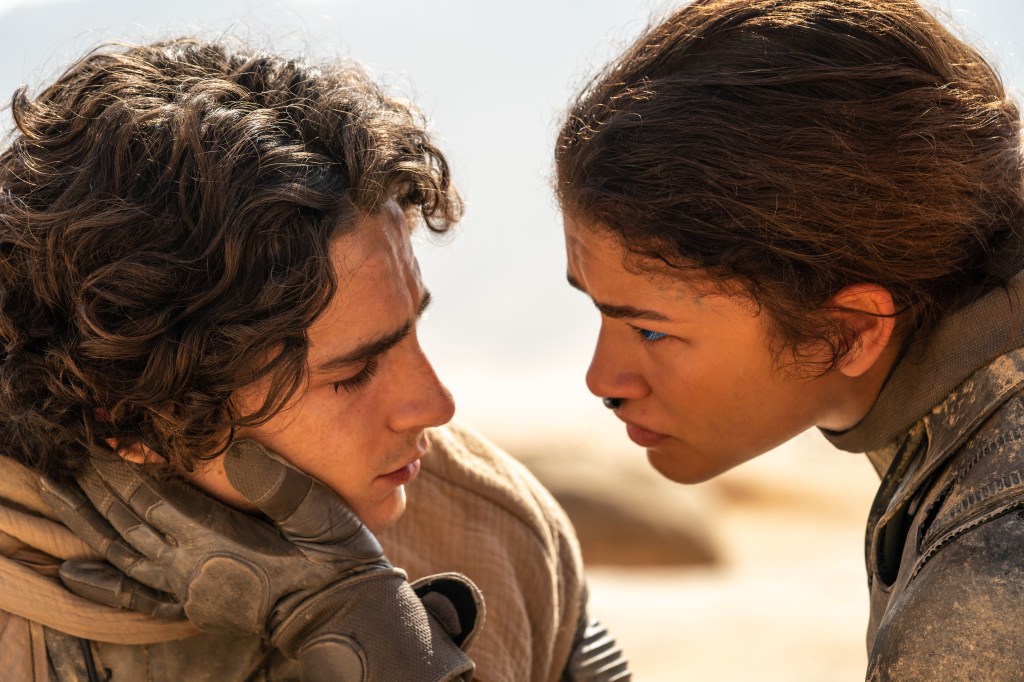
Let’s begin with the actors. The heavy lifting done by the performers on screen cannot be overstated. This is, in fact, some pretty hard science fiction; however, the cast, led by the returning Timothée Chalamet and Zendaya and supported by Rebecca Ferguson, Stellan Skarsgård, and Dave Bautista makes the Dune sequel seem effortless. Joining the team are Javier Bardem, Florence Pugh, and Christopher Walken. Worth highlighting is a terrifying turn from Austin Butler, who is borderline unrecognizable in his role. The performances are mesmerizing and immersive. It takes a lot to draw attention from the visual spectacle that is Dune: Part Two, but these actors are certainly up for the task and exceed expectations.
Visually, Dune: Part Two is a revelation. As filmgoers, it’s easy to become jaded with the visual effects presented on screen. Impossible things can only be seen so many times before audiences’ eyes start glazing over. However, it’s not the pixel peeping that wows in Dune: Part Two; it’s the little details. It’s how characters physically shift and are manipulated by gravity during VFX shots. It’s the realism of the environment, the shifting sands, as a worm makes its way around the Arrakis desert. Paired with what are no doubt practical effects meant to sell the little details in the movie further, it is seamless and a joy for the eyes. The little details make all the difference, and credit must be given to the army of VFX artists that made Dune: Part Two possible.

Two other factors play into the immersive nature of Dune’s universe. One is the sound design. In a theater with enough auditory firepower, one can feel this film. It allows Dune: Part Two to show instead of telling and hear instead of saying. The second factor in Hans Zimmer’s score. He’s one of the most recognizable figures in cinema, and Zimmer’s legacy is cemented at this point. Still, it should be said that his score adds to the storytelling present here that is not common in the modern cinema landscape.
If there’s a criticism, it’s that the film’s two-hour and 46-minute runtime could have been trimmed a bit. However, Dune: Part Two earns most of its runtime and doesn’t flinch at portraying complicated science fiction subject matter, doing so without dumbing down any of the content. Indeed, the film seems to respect its audience enough to simply tell the story. Too often, we see films with flashback scenes repeating events that happened moments ago on-screen. Here, the training wheels are off, and it’s a breath of fresh air. If Dune: Part Two is financially successful, one hopes the trend will continue with other films of its ilk.
Director Denis Villeneuve has quietly become one of the greatest filmmakers of his generation. His oeuvre has been bulletproof for over a decade. From Arrival, Blade Runner 2049, and Sicario to Dune, new additions to Villenueve’s library have been must-see. Dune: Part Two fits alongside those masterpieces, demonstrating what can be done with storytelling of all types.
Dune: Part Two is meant to be seen on the biggest screen with the best sound available. The film is cinematic excellence, created by some of the world’s best storytellers. It would be a disservice to wait to stream this one, as the film is what movie theaters were built for.

 Justin Walker
Leave a comment