Originally published to 8 News Now on June 7, 2024.
LAS VEGAS (KLAS) — To create content for a venue with the size and scope of Sphere, the team behind it needed to create custom technology never before seen outside of a laboratory. They also needed to make it portable enough to move from exotic locale to exotic locale, gathering immersive images that would eventually be used to transport viewers sitting inside the world’s largest spherical building elsewhere.
THERE WAS AN IDEA …
When it comes to figuratively painting on a canvas as massive as the 160,000-square-foot screen of Sphere in Las Vegas, it takes a metaphorical paintbrush as imaginative and powerful as the venue itself.

That’s why Andrew Shulkind and the team at MSG Sphere Studios developed Big Sky, a custom-assembled camera package invented specifically for the newest addition to the entertainment capital of the world’s skyline.
The journey to Big Sky began with a question. How do you provide such high-resolution content for a screen that, up until that point, didn’t yet exist?
PIXEL PEEPING
Sphere’s screen is 16,000 pixels by 16,000 pixels, or 16K. Shulkind’s team discovered that a smaller camera sensor, one that was currently available to filmmakers, would just not deliver the raw pixel load needed to fill Sphere’s pixel-hungry screen. For reference, a standard high-definition display has 2 million pixels, with a 4K television weighing in at more than 8 million pixels. Sphere’s screen has 256 million.
The team took a dozen of the most cutting-edge cameras into the field to see what they could accomplish with existing tech. They tried solutions that included stitching and warping the images from those cameras to fit the shape of what would become Sphere’s screen. The resulting Frankenstein’s monster of a rig weighed anywhere from 200 to 300 pounds and was not very mobile. Shulkind feared having to tell a filmmaker “no,” that they couldn’t capture the images the artist had imagined.
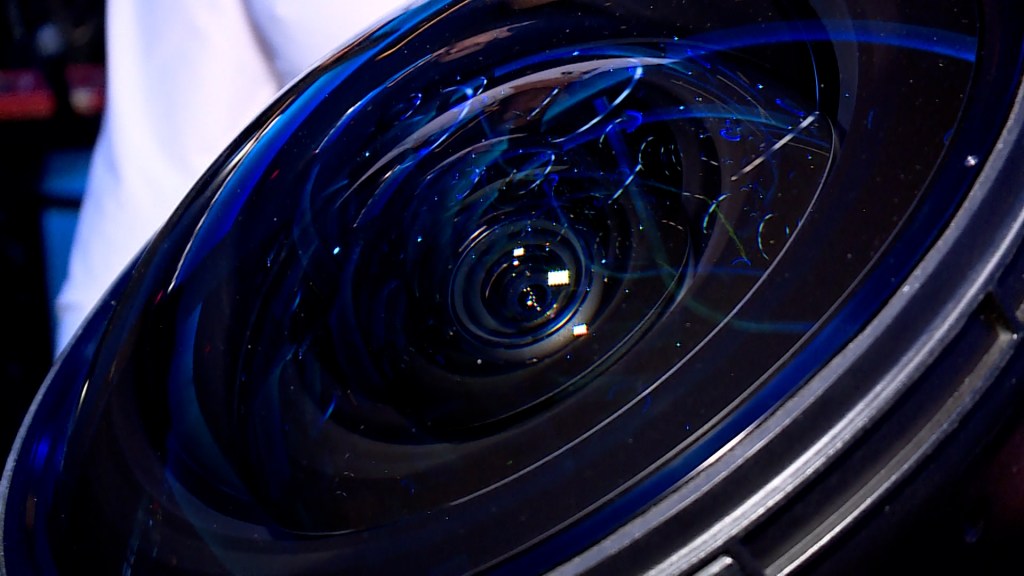
Instead, they did it themselves. The team set out to create a custom camera. One with stringent specs geared specifically for what would become Sphere. Alongside the camera came other demands. Custom software was created to manage the image created by the camera, custom compression was created to ensure that the video file sizes were at least manageable, and a custom lens was created and specifically tuned to Sphere’s screen.

The behemoth of a lens has an aperture of f/3.5, allowing a lot of light to reach the massive Polaroid picture-sized sensor and providing the Big Sky crew some leeway to use natural light on set. Additionally, it provides a sharp 165-degree field of view from one edge of the image to the other, meaning the audience can observe any part of the enormous screen without any loss of clarity from one point to another.

MAKING IT MOBILE
“You can create anything in a lab,” Shulkind said of the Big Sky project. “But to actually have it be something that you can hang from a helicopter and take into a volcano and hike into a cave with and to be able to actually make something […] that’s the thing.”
Shulkind believes Big Sky is at least five years ahead of what anyone else in the field is doing in imaging. He recalled the staging of a holy festival in Jaipur, India, specifically for Postcard from Earth, director Darren Aronofsky’s “Sphere Experience” regularly playing on Sphere’s screen since its opening in 2023. That production took Big Sky on a whirlwind adventure to 26 different countries on all seven continents. None of those shots would be possible if Big Sky had never evolved past its 300-pound form.
IT WORKS
With all the mind-blowing tech involved in Big Sky, Shulkind’s favorite part of the project is simple.
“It’s usable,” he said, calling to attention the deluge of tech announcements at the Consumer Electronics Show and NAB Show in Las Vegas. “But to have something that’s actually real and it’s usable and is like it’s the opposite of hype.”

Currently, the team is concentrating on generating content for Sphere, a platform that Shulkind believes they have barely begun to explore fully. Within that glowing orb, located adjacent to the Las Vegas Strip, there exists a portal that has the potential to transport the viewer, figuratively speaking, from the Nevada desert to anywhere in the world.
“You feel like you’re somewhere,” Shulkind said of the Sphere Experience. “If you feel like you’re somewhere else, you can change the world.”


 Justin Walker
Leave a comment