Originally published to 8 News Now on September 4, 2024.
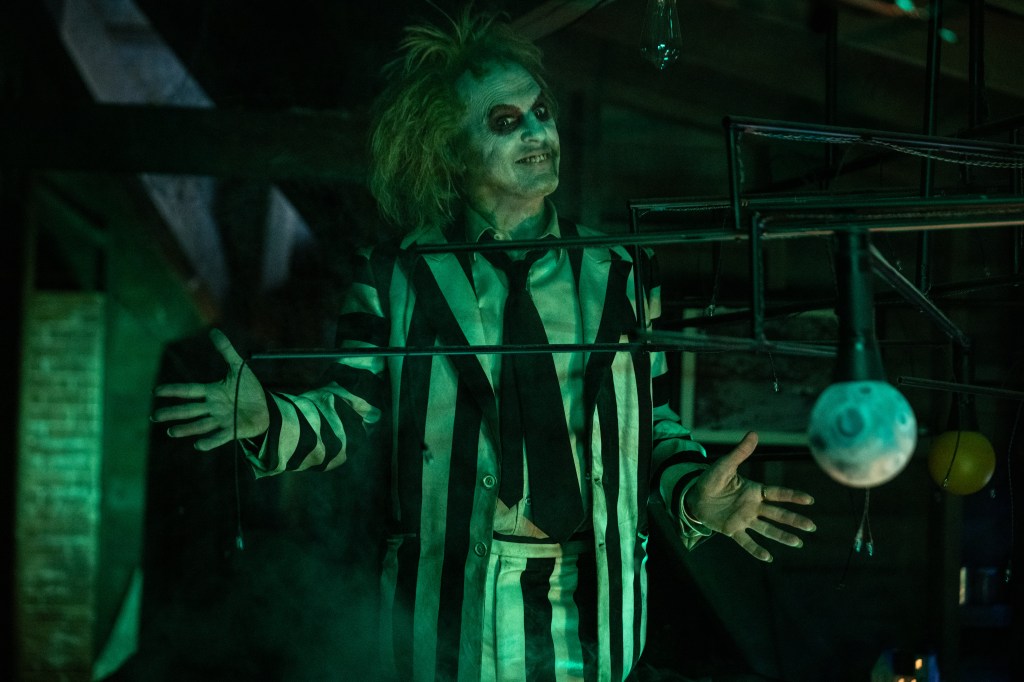
Friday will see the release of another sequel to a uniquely 80s movie, this one coming just three decades after the original. Famously, sequels to 1988’s “Beetlejuice” have long since dropped in and out of the Hollywood pipeline, including the bizarrely titled “Beetlejuice Goes Hawaiian,” which was never produced. Now, a short 36 years after the release of Beetlejuice, the cast and crew of the 1988 comedy reunite to do it one more time in “Beetlejuice Beetlejuice.”
The original film, one of the last remaining late-millennium films that hasn’t received the 21st-century “rebootquel” treatment, is loved by many, but not so much as to feel like the 2024 edition is treading on holy ground. Indeed, in 2024’s “Beetlejuice Beetlejuice,” Michael Keaton’s titular demon, who only received approximately 17 minutes of screen time in the original, has more time here, for better or for worse. His story is essentially joined already in progress. Where has Beetlejuice been over the last 30 years? Don’t really know. Doesn’t really matter. We get a little more detail about Winona Ryder’s life since the events of the original film, as well as that of her stepmother, Delia, played again by Catherine O’Hara. Additionally, we’re introduced to Lydia’s boyfriend Rory, played by Justin Theroux, and her daughter Astrid, portrayed by Jenna Ortega.

All the actors in the sequel play their parts well. Ryder, O’Hara, and Keaton all fall back into their roles with relative ease, while the newcomers fit in nicely. However, anyone who has watched the original film many times since its release is used to hearing these iconic jokes and phrases coming from these characters. In the 2024 sequel, Keaton never verges on anything quite as memorable as the little quips and jabs thrown in the 1988 classic. Ryder is the same; with Ortega as her daughter, she faces a mirror image of her teenage self, but nowhere is the sharp satire of the “goth girl” from the original film or the accessibility or loveable naivete of Alec Baldwin and Geena Davis’ Adam and Barbara.
The truth is that “Beetlejuice Beetlejuice” isn’t laugh-out-loud funny. There are certainly laugh moments, but the sharp tongue of its predecessor has been dulled to a non-threatening, blunt point. Whether a result of the aging filmmakers or the era in which it was produced, it’s simply forgettable.
What’s unforgettable, however, are the lengths that director Tim Burton went to make the movie feel tactile. The visual effects in the sequel are stunning. The marketing for every film in the 2020s seems to want to tell you that the filmmakers bypassed CG effects in an effort to keep the visuals practical. Certainly, this is rarely true. In the case of “Beetlejuice Beetlejuice,” there is clearly CG used in the production, but it’s built upon a fertile ground of painstakingly created practical effects that ground the film in reality and create a tangible and entertainingly macabre underworld comparable to that of the 1980s original.
Luckily, even if you’re not necessarily laughing all that much, it is nice to be back in this universe and live with these characters for the film’s runtime. With the fantastic visual effects and the familiar Danny Elfman score, “Beetlejuice Beetlejuice” is like slipping on an old, comfortable t-shirt. You may not remember it for years to come, but in the moment, it’s just what the doctor ordered.

 Justin Walker
Leave a comment