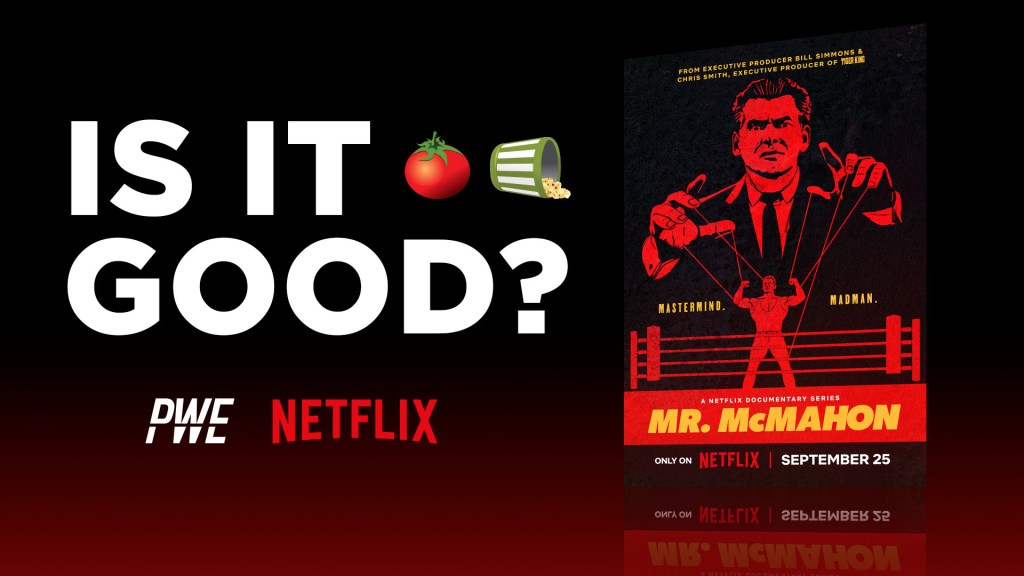
“I’ll give you enough to make it semi-interesting,” says Vince McMahon in the opening scenes of the new Netflix documentary “Mr. McMahon,” set to drop on Wednesday. “I don’t want anyone to really know me.”
“Mr. McMahon” retells in documentary form the story of the enigmatic former owner of World Wrestling Entertainment through archival footage and interviews with the man himself and many who have participated in creating the professional wrestling industry that exists today. Hulk Hogan, Tony Atlas, Bret Hart, Paul “Triple H” Levesque, Paul Heyman, Eric Bischoff, and even Bob Costas all participate, taking the chance to tell their side of the building of the behemoth wrestling company that today commands the industry.
Unwittingly, the documentary walks a line between being the most accessible, watchable retelling of the history of professional wrestling put to screen and being the story of Vince McMahon. Indeed, this doc makes it clear that you can’t truly tell the story of one without the other. It’s an uncomfortable duality faced by fans of the art form. On one hand, “Mr. McMahon” is a vivid, detailed, and thrilling trip down memory lane. It’s the business of professional wrestling shown through a previously inaccessible lens.
On the other hand, it presents the story of Vince McMahon, not just the on-screen character, but the man. A story that, as it turns out, is exceedingly ugly. The interviews included in the documentary were mostly shot before the most recent sex trafficking allegations against McMahon came to light and aren’t dealt with in any meaningful way within the first five episodes of the doc.
And about that sixth episode. Unfortunately, during the screening window for the documentary, “Mr. McMahon” leaked to the public. It’s not immediately clear if the entirety of the six-hour documentary got out or if portions of it made it online, but I was only able to watch five episodes of the doc before Netflix pulled it down. That leaves this review incomplete, missing the context of the all-important sixth hour, which seemed to be hurtling toward the most recent allegations.
However, the first five hours of “Mr. McMahon” might be the best-ever descriptive device to explain professional wrestling to someone who has never heard of it. The doc serves as a fantastic primer for how the WWE came to be what it is today, a $6.8 billion company with throngs of hungry audiences worldwide just waiting to eat up every piece of content it offers.
“Mr. McMahon” doesn’t so much cover the origins of professional wrestling as a whole. There’s no mention of Joseph “Toots” Mondt, Ed “Strangler” Lewis, or Billy Sandow, the “Gold Dust Trio” widely credited with the dawn of storytelling in the industry as it emerged from its “carney”-era cocoon. Here, we don’t go that far back. We are set firmly in the McMahon era of pro wrestling.
During the retelling of professional wrestling in the ideological ’80s and the grungy ’90s, moments every wrestling fan will remember are played on-screen like a meeting with the ghost of Christmas past. Now the sheen has rubbed off, and every filthy nook and crenny of the industry loved by so many is plainly visible. We re-experience these questionable moments and get to see the participants remembering them, some head in hand, explaining that “it was a different time.” Through it, Vince McMahon’s proud visage reappears on-screen again and again, either dismissing the damning moments with a hand-wavey reaction or being downright defiant of any judgment.
And like it or not, professional wrestling in 2024 exists thanks to Vince McMahon and the cadre of yes men that flanked him for decades. Like the on-screen character of Mr. McMahon and the behind-the-scenes enigma of Vincent Kennedy McMahon, professional wrestling is presented as a complicated duality. Whether it’s a grotesque car wreck of brutality, coercion, and sexual impropriety or a triumphant story of overcoming the odds and betting on yourself until the world bends to your will, the story of professional wrestling in America is inexorably linked to McMahon. It’s both. It’s the character and the man, Vince and Mr. McMahon — for better and worse.
This review remains incomplete until the missing sixth episode of “Mr. McMahon” becomes available. Unwittingly, Netflix has channeled sports entertainment by making the final episode, essentially the main event of the doc, similar to that of a three-hour WWE pay-per-view. I’m going to have to wait. What I’ve seen, however, is a compelling story of an industry that is uniquely American, warts and all, portrayed in an honest way that will keep eyes glued to the screen and fingers stuck to the “Continue” button when Netflix asks you if you’re still watching after a five-hour binge.

 Justin Walker
Leave a comment